
A brake fluid change usually runs about $89 to $289 in labor, depending on the car. That's the spread across seven popular models in RepairPal's estimates. Fluid, tax and shop fees come on top. It's money well spent when the fluid tests bad. Old fluid holds water, and water lowers the heat it can take before it boils.
Before You Say Yes to a Flush
- RepairPal puts brake bleed labor at $89 to $289 across seven popular models. Fluid and fees are extra
- A Toyota RAV4 costs about double a Jeep Grand Cherokee for the same job
- Michigan law says the shop owes you a written, itemized estimate before work starts
- Federal rules let DOT 3 fluid boil as low as 284 degrees once it takes on water. New, the floor is 401
- Ask for a test result first. Fluid at the wheels can be worse than fluid in the reservoir
You'll hear that a brake fluid flush is a quick lube upsell. Skip it, they say, and keep the money. The federal brake fluid rule tells a different story. Under FMVSS 116, new DOT 3 fluid can't boil below 401 degrees. After a lab test soaks it with water, the floor drops to 284 degrees.
Boiled fluid turns to vapor. Vapor squeezes, so the pedal goes soft right when you need it. That's what the service buys back. The real question is what it should cost and when it's actually due.
What Seven Popular Models Pay in Labor
RepairPal lists a "brake bleed" estimate for each model. That's the job that pushes old fluid out and new fluid in, then clears the air. These are labor numbers, last updated September 3, 2026. RepairPal says they don't account for your location, and they leave out tax and fees.
| Model | Labor Range |
|---|---|
| Jeep Grand Cherokee | $89 to $131 |
| Honda CR-V | $94 to $138 |
| Ford Escape | $96 to $141 |
| Ford F-150 | $102 to $150 |
| Chevy Silverado 1500 | $117 to $172 |
| Chevy Equinox | $119 to $175 |
| Toyota RAV4 | $197 to $289 |
RepairPal brake bleed estimates, labor only, updated September 3, 2026, opened November 2026.
Six of the seven land between about $90 and $175. The RAV4 sits alone at $197 to $289. RepairPal doesn't say why. So ask any shop how long your model takes, and why.
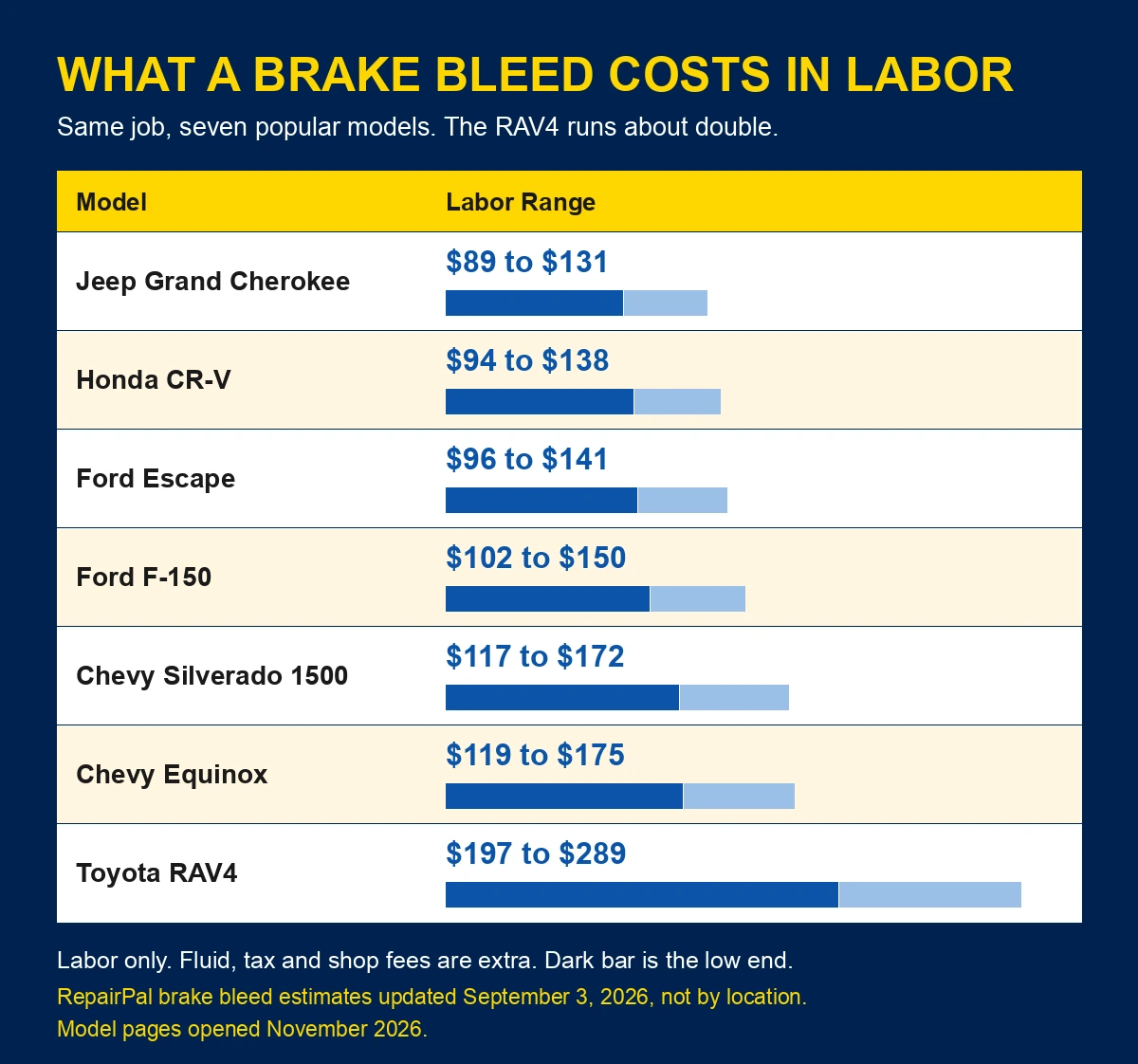
Those are labor numbers. The fluid shows up as its own line on the bill, so check the grade it lists.
What a Michigan Shop Has to Put in Writing
Michigan doesn't leave the price to a handshake. The Motor Vehicle Service and Repair Act covers it in MCL 257.1332.
- A written estimate comes first. Before work starts, the shop gives you one. It itemizes labor and parts as closely as it can.
- No surprise extras. The shop can't charge past the estimate without your OK. The one exception is a small overage of 10% or $50, whichever is less.
- Lower is yours. If the job comes in under the estimate, you pay the lower actual cost.
- Testing has a price tag up front. If the shop charges to diagnose, that cost goes in the written estimate before it starts.
So make the estimate say which job you're buying. A top off adds fluid. A reservoir swap pulls old fluid from the top and refills it. A full bleed pushes new fluid through every line to each wheel. Those are not the same job, and they shouldn't carry the same price.
Michigan also certifies mechanics by repair type. MCL 257.1310b lists brakes and braking systems as its own category. It's fair to ask who's doing the work and what they're certified in.
Why Old Fluid Is Worth Paying to Replace
DOT 3, DOT 4 and DOT 5.1 fluid is glycol based, and glycol soaks up moisture over time. Brake maker Bendix says most fluid takes on about 2% water in just 12 months.
FMVSS 116 sets two boiling floors for each grade. One is for fresh fluid. The "wet" one is for fluid tested after it soaks up water in the lab, about 3.7% by weight.
| Grade | Fresh Floor | Wet Floor |
|---|---|---|
| DOT 3 | 401°F | 284°F |
| DOT 4 | 446°F | 311°F |
| DOT 5 (silicone, purple) | 500°F | 356°F |
Minimum boiling points from FMVSS 116, 49 CFR 571.116, sections S5.1.1 and S5.1.2.
Look at DOT 3. It loses 117 degrees of margin between fresh and wet. Long hills, towing and hard stops all heat the brakes. Fluid with less margin boils sooner.
The same rule says DOT 5 silicone fluid must be purple. DOT 3, DOT 4 and DOT 5.1 run clear to amber. If your car calls for one of those, purple fluid in the reservoir is a red flag.
A Reservoir Test Can Miss Bad Fluid
A 2025 study in Acta Technologica Agriculturae tested brake fluid boiling points on cars of mixed age and miles. On 39 cars, the team sampled at both the reservoir and the brake caliper.
- 13% passed at the reservoir but failed at the caliper.
- Caliper fluid sometimes boiled up to 20 degrees Celsius lower. That's 36 degrees Fahrenheit.
- Older, higher mileage cars tended to boil lower.
That matters at the counter. A strip dipped in the reservoir looks at the cleanest fluid in the car. The fluid that heats up sits at the wheels. A pass at the top doesn't clear the whole system.
When It's Actually Due
Your owner's manual sets the schedule, and makers don't agree. Cars.com found the 2012 Nissan Leaf calls for new fluid every two years or 30,000 miles. On severe service, that's every year or 15,000 miles. The 2012 Toyota Camry calls for none through 12 years or 120,000 miles.
When the manual is quiet, test it. Bendix says to change the fluid when a test shows it's out of spec. Cars.com calls about 3% water the edge of the danger zone.
Book a check sooner if you notice any of these.
- The pedal feels soft or sinks lower than it used to.
- The fluid looks dark next to the new fluid on a shop shelf.
- The car tows, climbs long grades or works in stop and go traffic most days.
- You bought the car used and nobody knows when the fluid was last changed.
A soft pedal can also mean a leak or a worn master cylinder. That's a repair, not a fluid service. Our brake repair page lists what a soft or sinking pedal can point to.
Ways to Keep the Bill Down
- Get a reading first. Ask for the boiling point or water reading, and where on the car it was taken.
- Name the job. Ask if the price is a top off, a reservoir swap or a full bleed at all four wheels.
- Ask for the fluid type. It should match the grade your owner's manual lists.
- Pair it with brake work. When calipers or lines are already open, the system usually gets bled anyway. Ask how that changes the price.
- Skip the cheap tester as your only proof. Cars.com says home testers cost under $10 but may not carry any accuracy rating.
Calling Manko Mobile Auto
We come to the car at home or at work around Westland, on evenings and Saturdays. On a brake visit we look at the whole system, pads, rotors, calipers, hardware, hoses and fluid. Then we show you what we found before quoting the work. Fluids are part of our routine maintenance service too. Call (734) 292-8694 with the year, make and model, or request service online.
Leftover Questions
- How much does a full brake fluid change cost?
- RepairPal's labor estimates run about $89 to $289 across seven popular models, updated September 3, 2026. Most land between about $90 and $175. A Toyota RAV4 is the outlier at $197 to $289. Fluid, tax and shop fees are extra.
- Is a brake fluid flush really necessary?
- Yes, when the fluid tests bad or your manual says it's due. Under FMVSS 116, DOT 3 can boil as low as 284 degrees once it holds water, down from 401 new. Boiled fluid turns to vapor and the pedal goes soft.
- How often should you flush your brake fluid system?
- Follow the owner's manual. Cars.com found the 2012 Nissan Leaf calls for every two years or 30,000 miles, while the 2012 Camry calls for none through 12 years. If the manual is quiet, have the fluid tested.
- What happens if you don't change brake fluid?
- It keeps soaking up water. Bendix says most fluid takes on about 2% water in 12 months. More water means a lower boiling point, so the brakes can fade on long hills, towing or hard stops.
- What type of brake fluid do I need?
- The grade your owner's manual names. DOT 3, DOT 4 and DOT 5.1 are clear to amber. DOT 5 is silicone and federal rules make it purple. Don't swap grades without the maker's OK.
- Does changing brake fluid improve braking?
- It restores the boiling margin, which keeps the pedal firm when the brakes get hot. If the pedal was soft from air or moisture in the fluid, a proper bleed can firm it up. A leak still needs a repair.
Source Trail
| What We Cited | Where It Came From |
|---|---|
| FMVSS 116, 49 CFR 571.116, motor vehicle brake fluids | www.law.cornell.eduOpened November 2026 |
| RepairPal, Toyota RAV4 brake bleed cost (one of seven model pages) | repairpal.comOpened November 2026 |
| Michigan Legislature, MCL 257.1332, written estimate required | www.legislature.mi.govOpened November 2026 |
| Michigan Legislature, MCL 257.1310b, mechanic repair categories | www.legislature.mi.govOpened November 2026 |
| Bendix, Learn How to Change Your Brake Fluid | www.bendix.co.nzOpened November 2026 |
| Cars.com, How Often Do I Need to Change My Brake Fluid (Rick Cotta, 2023) | www.cars.comOpened November 2026 |
| Sarkan, Loman, Kosiba and Paumer, brake fluid boiling point study, Acta Technologica Agriculturae (2025) | reference-global.comOpened November 2026 |
About the author. Rani Manko runs Manko Mobile Auto in Westland and does the work himself. He has ten years in the trade, including two years at Ford as a diagnostic and drivability technician and six years of mobile auto repair across Wayne County.
See more of our car repair answers when you search Google.
Add Manko Mobile Auto as a preferred source on Google